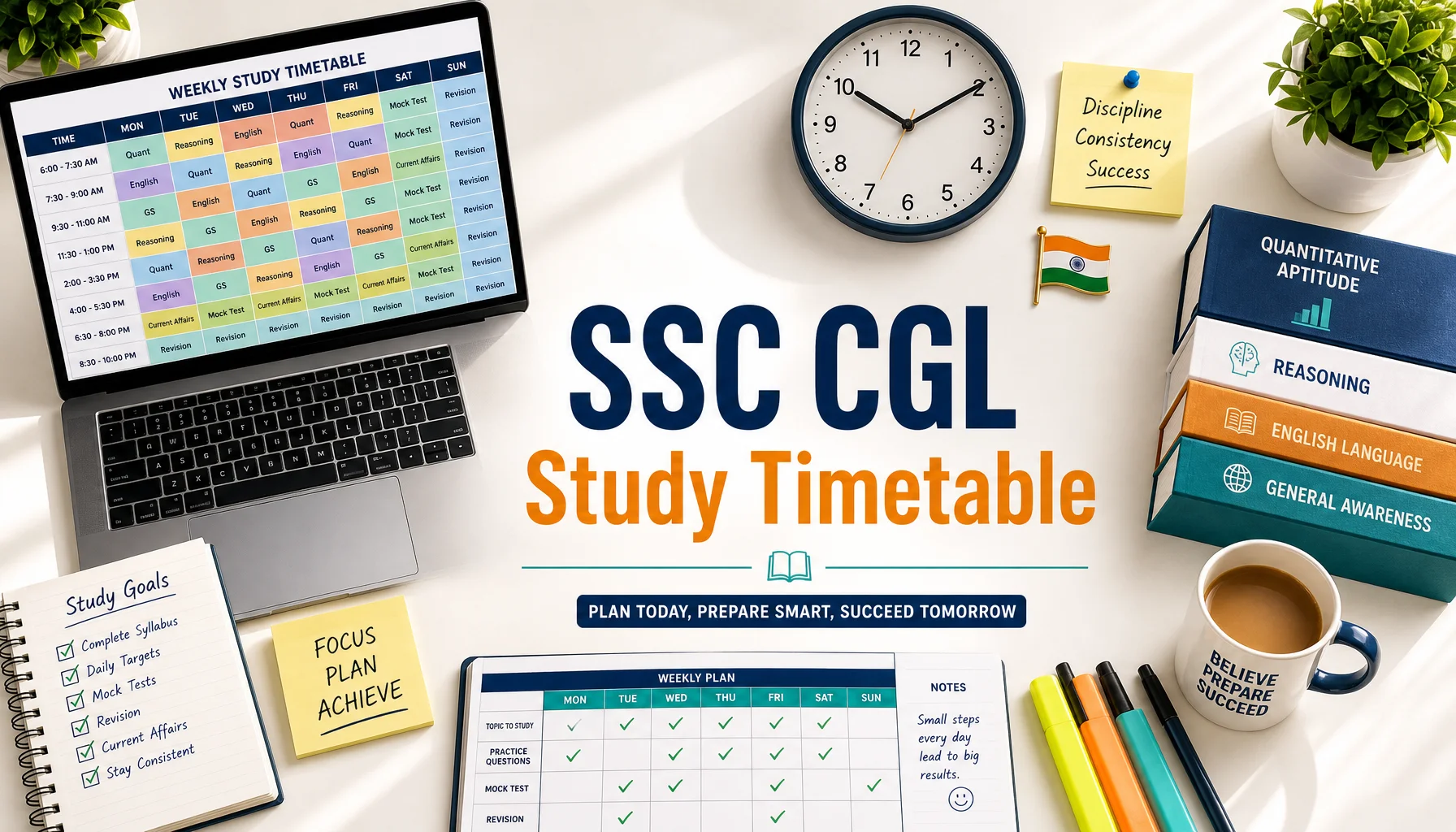
Preparing for the SSC CGL exam from the comfort of your home offers incredible flexibility, but it also demands serious self-discipline. Without a structured plan, online learners often find themselves jumping between topics, over-studying their favorite section, and neglecting weaker areas. The secret to consistent progress isn’t just working hard—it’s working smart with a well-designed study timetable. In this guide, we’ll walk you through practical scheduling strategies and share sample daily and weekly plans to help you balance all four sections of the SSC CGL exam while studying online.
Why a Timetable Matters for Online SSC CGL Preparation
When you’re studying at home, the boundaries between study time and leisure time blur easily. A timetable transforms vague intentions into concrete commitments. For SSC CGL aspirants specifically, a schedule ensures you give proportionate attention to all four sections:
- General Intelligence & Reasoning
- General Awareness
- Quantitative Aptitude
- English Comprehension
Neglecting even one section can pull down your overall score, since each carries equal weight in Tier 1. A balanced timetable prevents this imbalance and keeps you accountable.
Step 1: Assess Your Starting Point
Before building any schedule, take a diagnostic mock test. This helps you identify which sections are your strengths and which need extra hours. For example, if your Quantitative Aptitude score is weak, you’ll want to allocate more daily time there while still maintaining momentum in your stronger areas.
Divide your subjects into three tiers:
- Weak areas — need the most practice and revision time.
- Moderate areas — need steady, regular attention.
- Strong areas — need maintenance and periodic revision.
Step 2: Determine Your Available Study Hours
Be honest about how many hours you can realistically dedicate each day. Full-time aspirants might manage 6–8 hours, while working professionals or college students may only have 3–4 hours. Quality beats quantity—four focused hours will outperform eight distracted ones.
Break your available time into study blocks of 45–60 minutes, followed by short breaks. This technique, similar to the Pomodoro method, keeps your mind fresh and prevents burnout during long home study sessions.
Step 3: Follow the Rotation Principle
One of the biggest mistakes online learners make is studying only one subject per day. Instead, cover at least two to three sections daily. This rotation keeps every subject active in your memory and prevents the “cold start” problem where you forget concepts you haven’t touched in days.
A good rule of thumb is to pair a calculation-heavy subject (Quant) with a memory-based one (General Awareness) and a logic-based one (Reasoning), rotating English throughout the week.
Sample Daily Timetable for Full-Time Aspirants
Here’s a sample plan for someone with 6–7 hours available:
- 7:00 – 8:30 AM: Quantitative Aptitude (concept learning + practice)
- 8:30 – 9:00 AM: Break
- 9:00 – 10:30 AM: Reasoning (topic practice + puzzles)
- 10:30 – 11:00 AM: Short revision of yesterday’s topics
- 11:00 – 12:00 PM: English (grammar rules or vocabulary)
- Afternoon rest / light activity
- 4:00 – 5:00 PM: General Awareness + daily current affairs
- 5:00 – 6:00 PM: Sectional or full mock test practice
- 9:00 – 9:30 PM: Analysis of the day’s mistakes and notes review
Sample Daily Timetable for Working Professionals
If you have limited hours, focus on consistency and micro-learning throughout the day:
- Early morning (1 hour): Quantitative Aptitude practice
- Commute / lunch break: Vocabulary flashcards and current affairs via mobile apps
- Evening (1.5 hours): Reasoning and English alternately on different days
- Night (30 minutes): Revision and short quizzes
Reserve weekends for longer sessions, full-length mock tests, and detailed performance analysis.
Sample Weekly Plan
A weekly view ensures balanced coverage across all sections. Here’s how you might distribute focus:
- Monday: Quant (Arithmetic) + Reasoning + English (Grammar)
- Tuesday: Quant (Advanced Maths) + General Awareness + Vocabulary
- Wednesday: Reasoning (Non-verbal) + English (Comprehension) + Quant revision
- Thursday: Quant (Data Interpretation) + General Awareness + Reasoning
- Friday: English (Error Spotting) + Reasoning + Quant practice
- Saturday: Full-length mock test + detailed analysis
- Sunday: Weekly revision + weak-area focus + rest
- ssc sarkari result
Notice how current affairs and General Awareness appear on multiple days—this section rewards daily consistency more than any other.
Step 4: Build In Mock Tests and Analysis
Online learners have a huge advantage: unlimited access to digital mock tests. Schedule at least two to three sectional tests during the week and one full-length mock on the weekend. But taking the test is only half the work. Spend equal time analyzing your errors, understanding why you got questions wrong, and updating your notes. This feedback loop is what turns practice into improvement.
Step 5: Make It Sustainable
The best timetable is the one you can actually follow long-term. Keep these tips in mind:
- Include buffer time for topics that take longer than expected.
- Schedule one lighter day each week to avoid burnout.
- Track your progress using a simple diary or spreadsheet.
- Eliminate distractions by keeping your phone in another room during focused blocks.
- Review and adjust your plan every two weeks based on mock test results.
Common Timetable Mistakes to Avoid
As you design your schedule, watch out for these pitfalls:
- Over-scheduling with unrealistic hours that lead to guilt and quitting.
- Ignoring revision—new topics won’t stick without regular review.
- Studying only strong subjects because they feel rewarding.
- Skipping breaks, which reduces concentration and retention.
Conclusion
Creating a winning SSC CGL study timetable is about balance, consistency, and honest self-assessment. As an online learner, you have the freedom to design a schedule that fits your life—use that flexibility wisely. Start by understanding your strengths and weaknesses, rotate your subjects daily, integrate regular mock tests, and always leave room for revision. Remember, the perfect timetable isn’t the most intense one; it’s the one you can follow every single day until exam day. Build your plan today, stay disciplined, and watch your preparation transform into results.